Vacuum technology

Dry Compressing Screw Vacuum Pump

Dry Compressing Screw Vacuum Pump: A Complete Guide to Oil-Free Industrial Vacuum Solutions

Introduction In today’s industrial world, vacuum technology plays a vital role in ensuring productivity, cleanliness, and reliability. Among the wide range of vacuum pump technologies available, the dry compressing screw vacuum pump has emerged as a preferred choice for industries demanding oil-free performance, reduced maintenance, and energy efficiency. At LeyboldExim.com, we specialize in delivering advanced vacuum pump solutions, including dry compressing screw vacuum pumps, tailored to the needs of sectors such as food processing, metallurgy, coating, solar, packaging, and pharmaceuticals. This article provides an in-depth look at how these pumps work, their benefits, applications, and why choosing a Leybold solution ensures long-term reliability. What Is a Dry Compressing Screw Vacuum Pump? A dry compressing screw vacuum pump operates on the principle of two parallel screw rotors rotating in opposite directions within a chamber. These rotors trap incoming gases, compress them, and expel them toward the exhaust. Unlike traditional lubricated pumps, no oil or liquid is used in the compression chamber. This ensures that gases remain uncontaminated throughout the process. The result is a clean, efficient, and environmentally safe vacuum solution that supports sensitive industrial processes where contamination is not acceptable. Key Advantages of Dry Compressing Screw Vacuum Pumps 1. Oil-Free Operation The most significant advantage of these pumps is their hydrocarbon-free performance. Since there is no oil in the compression chamber, the pumped gases remain pure. This is critical in industries like food packaging, medical device production, and semiconductor manufacturing, where even the slightest contamination can compromise product quality. 2. High Reliability Dry screw pumps are built with robust engineering, often incorporating thermally optimized rotors, non-contacting seals, and durable bearings. This ensures high uptime, even in demanding applications where pumps operate continuously under harsh conditions. 3. Low Maintenance Design With fewer wearing parts and no need to manage lubricants in the compression chamber, these pumps require minimal servicing. Many models allow easy disassembly and cleaning, ensuring reduced downtime and lower maintenance costs. 4. Energy Efficiency Modern screw pumps are equipped with frequency converters and smart control systems, allowing them to adapt energy usage to the process demand. This makes them more energy-efficient compared to older pump technologies, helping industries save on long-term operating costs. 5. Wide Application Range Dry compressing screw vacuum pumps are versatile. They can handle everything from sensitive clean processes like food and pharmaceuticals to challenging industrial environments such as heat treatment, metallurgy, or coating operations. Working Principle of Screw Vacuum Pumps The working process of a screw vacuum pump involves four stages: This continuous and smooth pumping action ensures consistent vacuum performance, even during long operating cycles. Popular Leybold Dry Screw Pump Models At LeyboldExim.com, we provide a wide selection of dry compressing screw vacuum pumps, designed to meet the needs of diverse industries: Applications of Dry Compressing Screw Vacuum Pumps Dry screw vacuum pumps are widely used across industries due to their adaptability: Comparison: Dry Screw vs. Other Vacuum Technologies Feature Dry Compressing Screw Pump Oil-Sealed Rotary Vane Pump Roots Pump (Backed) Oil Contamination Risk None High Low Maintenance Requirements Low Medium Medium Energy Efficiency High Moderate High (with system) Suitable for Harsh Gases Yes No Yes (with backing pump) Operating Costs Lower (long-term) Higher (due to oil upkeep) Medium This comparison highlights why dry screw technology is increasingly replacing traditional oil-sealed pumps in modern industries. Maintenance Tips for Long Life Even though these pumps are low-maintenance, proper care ensures maximum performance: Why Choose LeyboldExim.com for Dry Screw Pumps? Conclusion The dry compressing screw vacuum pump represents the future of vacuum technology—oil-free, efficient, and robust. With benefits such as high reliability, reduced maintenance, and clean operation, it is the perfect choice for industries striving for productivity and quality. Whether your process involves food packaging, metallurgy, solar panel production, or pharmaceutical manufacturing, LeyboldExim.com has the right solution. By choosing Leybold’s advanced vacuum pumps, you’re investing in long-term efficiency, safety, and performance.

Dry Compressing Screw Vacuum Pump: A Complete Guide to Oil-Free Industrial Vacuum Solutions Read More »

2 Stage Vacuum Pump

2 Stage Vacuum Pump: A Complete Guide for Industrial and Scientific Applications

Introduction In today’s fast-paced industrial and scientific environments, efficiency and reliability are key factors when it comes to vacuum technology. A 2 stage vacuum pump is one of the most versatile and effective solutions available. It is widely used across industries such as pharmaceuticals, food packaging, laboratories, semiconductors, refrigeration, and HVAC. The dual-stage mechanism makes it superior to single-stage pumps in terms of deeper vacuum levels, efficiency, and durability. This blog explores what a 2 stage vacuum pump is, how it works, its advantages, common applications, and why choosing a trusted supplier like LeyboldExim is essential for long-term performance and support. What Is a 2 Stage Vacuum Pump? A 2 stage vacuum pump is designed with two separate pumping stages operating in sequence. The first stage handles the initial evacuation by removing the majority of air and gases. The second stage then takes over to achieve much deeper vacuum levels. This two-step process allows the pump to reach ultimate pressures that single-stage pumps cannot achieve. The technology is most often applied in rotary vane pumps, where vanes rotate within a chamber to compress and discharge gas. In a two-stage configuration, the gas passes through two chambers, significantly reducing the residual pressure. How Does a 2 Stage Vacuum Pump Work? Key Advantages of a 2 Stage Vacuum Pump 1. Deeper Vacuum Levels A two-stage system can achieve significantly lower ultimate pressures than single-stage pumps, often reaching below 0.001 mbar. This is critical for industries like semiconductor manufacturing, freeze-drying, and thin-film deposition. 2. Higher Efficiency By dividing the workload into two stages, the pump operates more efficiently. The second stage requires less effort because the gas has already been partially evacuated in the first stage. 3. Faster Evacuation Two-stage pumps can evacuate chambers more quickly, which reduces downtime and improves productivity in time-sensitive industrial processes. 4. Improved Durability Because the load is distributed between two stages, wear and tear on internal components is minimized. This results in longer service life and reduced maintenance costs. 5. Versatile Applications From HVAC servicing to advanced scientific research, 2 stage vacuum pumps are adaptable to a wide range of uses. Their versatility makes them a cost-effective choice for industries with diverse vacuum requirements. Applications of 2 Stage Vacuum Pumps 1. Laboratories and Research Used in experiments requiring precise vacuum levels, such as analytical instruments, freeze-drying, and material testing. 2. Semiconductor Manufacturing Critical for thin-film deposition, etching, and coating processes that demand stable high vacuum conditions. 3. Food and Beverage Packaging Essential in vacuum-sealing and freeze-drying applications, preserving product quality and extending shelf life. 4. Refrigeration and HVAC Used for evacuating refrigerant systems, removing moisture, and ensuring leak-free operation. 5. Industrial Coating Ensures uniform coating thickness and high product quality in manufacturing processes. 6. Automotive Industry Applied in AC servicing, brake line bleeding, and fuel system maintenance. Technical Features of Modern 2 Stage Vacuum Pumps 2 Stage vs. Single Stage Vacuum Pump Feature Single Stage Vacuum Pump 2 Stage Vacuum Pump Vacuum Depth Moderate (down to ~1 mbar) High (down to ~0.001 mbar or lower) Efficiency Lower Higher Evacuation Speed Slower Faster Durability Standard Extended life span Applications General purpose Precision and critical industries This comparison shows why industries with demanding vacuum requirements prefer the 2 stage vacuum pump. Why Choose LeyboldExim for 2 Stage Vacuum Pumps? Maintenance Tips for 2 Stage Vacuum Pumps Proper care and preventive maintenance ensure that a 2 stage vacuum pump continues to deliver top performance. Here are essential tips: Future of 2 Stage Vacuum Pumps With industries advancing towards higher precision and energy efficiency, the role of 2 stage vacuum pumps will only grow stronger. Innovations such as eco-friendly lubricants, smart sensors for predictive maintenance, and integration with digital monitoring systems are shaping the future of vacuum technology. Leybold, known for its innovative engineering, continues to pioneer advanced pump designs that meet evolving industrial demands. Conclusion A 2 stage vacuum pump is a critical tool for industries that demand high performance, deep vacuum levels, and consistent reliability. Its dual-stage operation offers advantages in efficiency, durability, and versatility, making it indispensable in sectors ranging from laboratories and food packaging to semiconductors and HVAC. At LeyboldExim, customers can access world-class Leybold 2 stage vacuum pumps backed by technical expertise, service reliability, and long-term value. Investing in the right pump today ensures productivity, precision, and sustainability for tomorrow.

2 Stage Vacuum Pump: A Complete Guide for Industrial and Scientific Applications Read More »

Why Oil Free Vacuum Technology is the Game Changer for Semiconductor Solar Panel Manufacturing

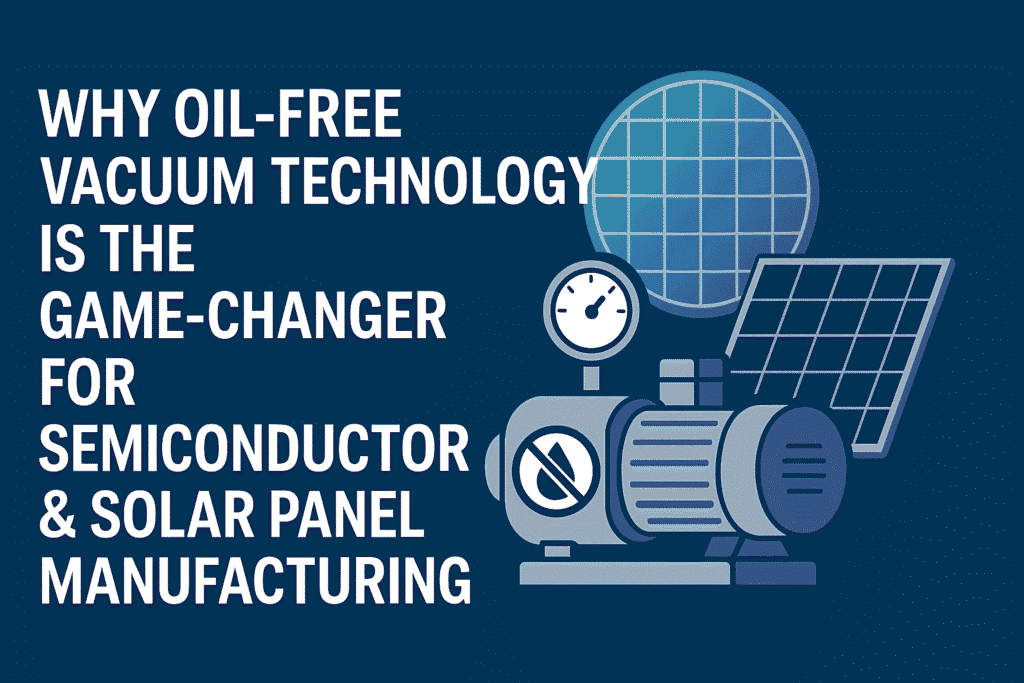
Why Oil-Free Vacuum Technology is the Game-Changer for Semiconductor & Solar Panel Manufacturing

In industries like semiconductor fabrication and solar panel production, precision and cleanliness are not just important — they are critical. Even the slightest contamination can compromise product quality, reduce efficiency, or lead to costly rework. That’s where oil-free vacuum technology is revolutionizing the way manufacturers achieve reliable, contamination-free performance. The Growing Need for Clean Vacuum Solutions As demand for microelectronics and renewable energy surges, manufacturers are under pressure to deliver high-quality products at scale. Traditional oil-sealed vacuum pumps, while effective, often carry risks of backstreaming oil vapor into clean environments. This contamination risk makes them unsuitable for ultra-sensitive applications such as: Oil-free vacuum pumps eliminate this risk by operating without lubrication in the vacuum chamber, ensuring clean, particle-free, and oil-free environments. What Makes Oil-Free Vacuum Pumps Different? Unlike oil-sealed pumps, oil-free systems use dry compression mechanisms (like screw, claw, or scroll technology) to generate vacuum. Key Advantages of Oil-Free Vacuum Technology: Why It Matters for Semiconductor Manufacturing Semiconductor fabrication requires extreme precision, often at the nanometer scale. Even microscopic oil particles can ruin wafers worth thousands of dollars. Oil-free vacuum pumps ensure: For fabs (semiconductor fabrication plants), this translates into greater profitability and lower waste. Why It Matters for Solar Panel Production In the race for renewable energy, solar manufacturers are scaling up production. Oil-free vacuum pumps play a crucial role in: By using oil-free technology, solar manufacturers achieve longer-lasting, more efficient panels that meet global quality standards. Leybold Oil-Free Vacuum Solutions Leybold offers a wide range of oil-free vacuum pumps tailored for high-tech industries: With advanced features like Energy Saver and remote monitoring, Leybold ensures not only performance but also reduced operational costs. Future of Manufacturing with Oil-Free Technology As industries demand higher efficiency, stricter compliance, and greener operations, oil-free vacuum pumps will become the new standard. For manufacturers in semiconductors, solar panels, and other high-tech sectors, switching to oil-free vacuum technology means: Conclusion Oil-free vacuum technology is more than an upgrade — it’s a game-changer for industries where purity and precision define success. Whether you’re producing semiconductors or solar panels, investing in oil-free solutions ensures greater efficiency, reliability, and competitiveness in a fast-evolving market.

Why Oil-Free Vacuum Technology is the Game-Changer for Semiconductor & Solar Panel Manufacturing Read More »

Vacuum Systems for Solar Cell and Architectural Glass Coating

Vacuum Systems for Solar Cell and Architectural Glass Coating

In industries where precision and efficiency define success, vacuum technology has become a cornerstone for achieving high-quality results. Two sectors that benefit significantly from advanced vacuum systems are solar cell manufacturing and architectural glass coating. These applications demand not only energy efficiency but also the highest standards of surface quality, which vacuum systems are uniquely capable of delivering. Why Vacuum Systems Are Essential Vacuum technology creates controlled environments free from air, moisture, and contaminants. This clean, stable atmosphere is vital for industries where even the slightest impurity can reduce efficiency or durability. By eliminating external influences, vacuum systems ensure uniform coatings, improved adhesion, and long-term reliability. Vacuum Systems in Solar Cell Manufacturing Solar cells are at the heart of renewable energy. Their performance depends heavily on the thin films applied during the manufacturing process. Vacuum systems enable: Using vacuum technology, manufacturers can achieve higher efficiency solar panels while reducing overall production costs. Vacuum Systems for Architectural Glass Coating Modern buildings demand energy-efficient glass that reduces heat transfer while maintaining clarity. This is made possible by vacuum coating systems, which provide: By leveraging vacuum deposition, architectural glass can meet sustainability standards while offering aesthetic appeal. Benefits of Vacuum Systems in These Industries LeyboldExim: Your Partner in Vacuum Technology At LeyboldExim, we specialize in delivering advanced vacuum systems and solutions tailored for solar cell manufacturing and architectural glass applications. Our expertise ensures that industries can achieve higher output, energy savings, and sustainable production goals. Whether you are a solar manufacturer or a glass coating company, LeyboldExim vacuum technology will help you stay ahead in efficiency and innovation

Vacuum Systems for Solar Cell and Architectural Glass Coating Read More »

What Type of Oil Does a Vacuum Pump Use

What Type of Oil Does a Vacuum Pump Use?

When it comes to vacuum technology, one of the most common questions is: what type of oil does a vacuum pump use? The answer depends on the type of pump and the application it is serving. Choosing the right oil is critical because it directly affects performance, efficiency, and the life of the pump. At Leybold Exim, we offer a wide range of vacuum pumps—from oil-sealed rotary vane pumps to dry-compressing pumps and Roots blowers. Let’s break down which pumps require oil, which operate oil-free, and the role oil plays in extending the reliability of your system. Why Vacuum Pump Oil Matters Vacuum pump oil is more than just a lubricant. In oil-sealed pumps, it: Using the wrong oil can cause reduced efficiency, higher energy use, and premature pump failure. Types of Vacuum Pump Oils Which Leybold Exim Pumps Use Oil? Leybold Exim offers a wide selection of pumps to suit different industries. Here’s how oil plays a role in each type: Oil-Sealed Rotary Vane Pumps These pumps require special rotary vane pump oil to ensure proper sealing and smooth operation. The oil is crucial for achieving reliable vacuum levels and reducing maintenance downtime. Oil-Free Dry Pumps These pumps are designed for applications where contamination must be avoided. They operate without oil in the compression chamber, making them perfect for clean environments such as food, pharmaceuticals, and electronics. Roots Blowers Roots blowers themselves don’t use oil in the compression stage, but they are often paired with oil-sealed or dry pumps. They help boost pumping speed and improve overall system efficiency. Choosing the Right Oil for Performance Final Thoughts The type of oil your vacuum pump requires depends entirely on the pump model and application. Oil-sealed pumps such as SOGEVAC, SOGEVAC NEO D, and TRIVAC L rely on specialized vacuum pump oils for peak performance, while dry pumps like CLAWVAC, VARODRY, NOVADRY, DRYVAC, and SCREWLINE eliminate oil from the process altogether. Meanwhile, RUVAC Roots blowers enhance system efficiency and typically operate in combination with either oil-sealed or dry pumps. By selecting the right oil—or oil-free solution—you ensure longer pump life, reliable vacuum levels, and cost-effective performance.

What Type of Oil Does a Vacuum Pump Use? Read More »

What Is Vacuum

How to Identify Vacuum System Leaks Quickly and Accurately

Is a Leak Holding Up Your Production? Imagine a food packaging line suddenly slowing down, vacuum-sealed containers failing to meet quality standards or lab results becoming inconsistent. The culprit? A vacuum leak—silent but costly. In the food manufacturing industry, leaks in vacuum systems can lead to energy loss, compromised product integrity, and unexpected downtime. These issues not only hurt productivity but also raise safety concerns. The good news? You can detect and fix vacuum leaks quickly and accurately—if you know what to look for and which methods to use. Common Signs of a Vacuum Leak Before diving into high-tech solutions, let’s cover the basics. Watch out for these simple indicators: Step-by-Step Leak Detection Methods (Speed Meets Precision) Let’s explore four proven ways to find leaks—ranging from quick fixes to precision tools used in top U.S. food plants. 1. Soap Bubble Test (Simple & Effective) What it is: A budget-friendly and fast method to detect visible leaks. How it works: Best for: Large, visible leaks around fittings or connections. 2. Helium Leak Detector (High Sensitivity, High Accuracy) What it is: An advanced tool that detects even the tiniest leaks. How it works: Why it’s ideal: Helium is non-toxic, doesn’t react with food-grade environments, and easily identifies leaks too small for bubbles or sound. Best for: Critical packaging lines and vacuum chambers in food-grade environments. 3. Pressure Decay Test (Simple DIY Check) What it is: A passive but powerful diagnostic test. How it works: Best for: Routine system checks without specialized tools. 4. Ultrasonic Leak Detector (For Tiny, Hard-to-Find Leaks) What it is: A handheld device that listens for ultrasonic frequencies (high-pitched sounds produced by leaks). How it works: Helpful Tip: For the most accurate results, use in quiet environments. Best for: Identifying micro-leaks in sterile food packaging or vacuum sealers. Pro Tips for Leak Detection Accuracy Whether you’re scanning a vacuum packaging unit or a freeze-drying line, precision matters. Here’s how to sharpen your results: Conclusion: Don’t Let Leaks Drain Your Operations Vacuum system leaks are silent productivity killers—especially in high-stakes environments like U.S. food manufacturing. However, with the right tools and a proactive approach, you can detect and address them before they cause significant setbacks. Combine fast methods, such as the soap bubble test, with advanced tools like helium leak detectors from Leybold for comprehensive results. Want more insights on vacuum leak detection, maintenance tips, or product guides? Fill out the form or visit leyboldexim.com for expert resources and precision tools tailored to your industry.

How to Identify Vacuum System Leaks Quickly and Accurately Read More »

Skip to content